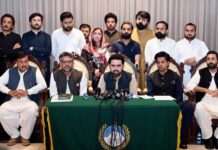
Rain-hit long march raises questions over CM Afridi leadership as unemployment rate raises to 9.6pc in KP
PESHAWAR, (APP): The rain-hit long march led by Khyber Pakhtunkhwa Chief Minister Sohail Afridi has triggered fresh questions over political leadership, organisational preparedness and the welfare of party workers after participants travelling from Lakki Marwat and other southern districts towards Matni, Peshawar, faced torrential rain, hailstorm, cold weather and exhaustion.
The participants, who responded to the PTI call for the long march, were exposed to harsh weather conditions as heavy rain disrupted their movement and created difficulties in arranging shelter, food and other basic facilities.
The situation became particularly challenging for elderly participants, chest patients and those who had travelled long distances to reach the gathering point.
The adverse weather also brought into focus the question of PTI leadership presence during difficult situation.
Analysts said that the real test of political leadership comes when workers and supporters face difficult circumstances on the ground, arguing that senior leaders are expected to share hardships and ensure that adequate arrangements are in place for those mobilised in response to their call.
The reported return of Chief Minister Afridi to Peshawar, while many participants remained exposed to torrential rain and cold, has consequently become a subject of political criticism.
Political opponents have questioned whether the PTI leadership should have remained physically present with workers during the difficult phase of the mobilisation, particularly when elderly people, patients and participants from distant districts were facing fatigue and inclement weather.
The episode has also placed the organisational arrangements of the uncalled for long march under scrutiny, with questions being raised about the availability of tents, shelter, food and clean drinking water.
Many participants left the Mathani venue before the Chief Minister’s address, citing difficult weather conditions and inadequate facilities.
The relatively thin turnout in Mathani has further complicated the political optics of the mobilisation. Despite extensive publicity of the long march through PTI’s social media platforms and calls for maximum participation, the response from local residents remained very limited, according to political circles and residents.
The road blockades associated with the march also caused inconvenience to motorists, students, teachers and government employees, many of whom remained stranded or faced prolonged delays on roads.
ANP leader and MPA Arbab Usman said the people of Khyber Pakhtunkhwa were more interested in jobs, employment and economic opportunities than political marches.
He said the provincial government should focus on addressing unemployment, illiteracy, terrorism and other socioeconomic challenges instead of diverting attention towards political agitation.
According to the Pakistan Bureau of Statistics’ Labour Force Survey 2024-25, KP’s unemployment rate stood at 9.6 per cent, making employment generation a major challenge for the province.
Arbab Usman also drew attention to worsening air pollution in Peshawar, urging the provincial government to take concrete measures to protect public health and control environmental pollution.
Health experts have repeatedly warned that prolonged exposure to polluted air increases the risk of respiratory diseases, including Chronic Obstructive Pulmonary Disease (COPD), which can severely affect quality of life.
Senior pulmonologist Dr Sirzaman Khan said women living in rural areas could be particularly vulnerable because of prolonged exposure to smoke from wood-burning stoves used for cooking.
He said COPD could be associated with smoking, environmental pollution and other risk factors, while symptoms commonly include breathlessness, chronic cough, excessive mucus production and fatigue.
Dr Sirzaman stressed that many patients seek medical attention only after significant lung damage has occurred. He said the disease could severely restrict routine activities, including climbing stairs and performing household chores, while patients could also experience anxiety, depression and other psychological difficulties.
The health concerns added another dimension to the debate over political priorities in KP, where critics argued that the provincial government needs to give greater attention to employment, healthcare, controlling environmental pollution, improving law and order and other issues directly affecting people’s daily lives.
The rain-hit long march at Mathani Peshawar has therefore evolved beyond a question of political mobilisation, emerging as a test of whether political organisations can translate slogans of sacrifice and commitment into practical arrangements for their workers.
For the PTI leadership, the episode poses a difficult political question that when workers are asked to remain on the streets in adverse weather for a political cause, how far should the leadership go in sharing their hardships and ensuring their safety, food and shelter?
The answer, political observers said, could ultimately shape public perceptions of the leadership, organisational capacity and credibility of the ongoing mobilisation.
Professor Dr Zahid Anwar of political science department at University of Peshawar said that politcal tolerance was prerequisite for strengthening and continuity of demcratic system.
He expressed the hope that PTI leadership will positively reciprocate to the Prime Minister Muhammad Shehbaz Sharif’s dialogue offer and called off the longmarch imperative for a meaningful dialogue for resolution of existing challenges faced by the KP today.