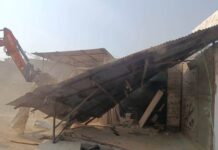
Reclaiming Peshawar: Anti-encroachment drive brings relief to people
PESHAWAR (APP): For years, walking through the crowded streets and historic bazaars of Peshawar had become a daily test of patience for thousands of residents, shoppers, pedestrians and motorists, as unchecked encroachments gradually swallowed footpaths, narrowed roads and turned once-accessible commercial centres into congested passageways.
What should have been a short walk to a nearby shop at Qisakhwani and Khyber bazzars often meant squeezing through narrow spaces, navigating roadside stalls and avoiding fast-moving vehicles.
For elderly citizens, women carrying children, persons with disabilities and school-going students at Warsak Road, the situation was even more difficult, as many were forced to share busy roads with motorists due to the occupation of designated pedestrian pathways.
However, a recently launched anti-encroachment campaign by the Khyber Pakhtunkhwa government has raised fresh hopes among residents for a cleaner, safer and better-organized provincial capital, as authorities move to reclaim public spaces from illegal structures and unauthorized extensions.
The ongoing operation, involving the district administration, police and Tehsil Municipal Administration (TMA), has targeted encroachments in several major commercial areas, including historic Khyber Bazaar, Qissa Khwani Bazaar, Hashtnagri, Firdus and other localities.
The initiative is being widely welcomed by citizens and civil society representatives, who believed that restoring roads and footpaths to their original purpose is a necessary step towards easing traffic congestion, improving commercial activities and preserving the historic character of Peshawar.
For ordinary residents, the campaign is not simply about removing roadside stalls, temporary structures or unauthorized extensions. Rather, it represents a solid effort to restore their basic civic right to walk freely, access markets conveniently and use public spaces without facing unnecessary obstacles.
In busy commercial centres such as Khyber Bazaar, Qissa Khwani, Hashtnagri and Faqirabad, encroachments had gradually occupied substantial portions of pedestrian pathways and roads, leaving little room for people to move freely.
During peak business hours, the situation frequently resulted in traffic bottlenecks, long queues of vehicles and considerable inconvenience for shoppers and traders.
The problem had also affected commercial activities, as customers often avoided congested markets because of limited parking facilities, blocked entrances and difficulties in reaching shops.
Member Provincial Assembly Tariq Awan described the anti-encroachment operation as a long-awaited demand of the people and appreciated the provincial government for taking practical steps to clear the historic bazaars.
“Encroachments had deprived citizens of essential civic facilities and created serious difficulties for shopkeepers, traders and the general public. The removal of illegal structures is a positive step towards restoring order and facilitating business activities,” he said.
He observed that the problem had continued to grow over the years because of weak enforcement and inadequate urban management, making it increasingly difficult for citizens to move freely and conduct business in major commercial areas.
For residents, particularly senior citizens, persons with disabilities, women and children, the restoration of footpaths carries special significance, as unobstructed pedestrian routes are directly linked with their safety, independence and everyday convenience.
The impact of encroachments is not confined to the historic city centre. On major arteries such as Warsak Road, Ring Road and Faqirabad, roadside encroachments and traffic congestion have also made daily commuting a frustrating experience for transporters, parents and schoolchildren.
“We often remain stranded for hours on Warsak Road during the time students are being transported from schools to their homes because of encroachments and traffic congestion. We appeal to the KP Government to expedite the operation on Warsak Road as well,” said local transporter Ehsan Ali while talking to APP.
He said patients travelling to hospitals also suffered because ambulances and other vehicles frequently faced difficulties in navigating congested roads, adding that timely action was needed to ensure smooth traffic movement on major city routes.
For parents, an unobstructed road means greater safety for children returning from school, while for patients it can reduce delays in reaching medical facilities. Similarly, a clear footpath can make the difference between an elderly person walking independently and being forced to negotiate a dangerous stretch of moving traffic.
The benefits of an organized commercial environment are equally significant for shopkeepers and traders. Markets with accessible entrances, clear pedestrian routes and improved traffic flow are more likely to attract customers, encourage shopping and support economic activity.
Peshawar, renowned for its centuries-old commercial traditions, historic architecture and vibrant bazaars, has long served as a major trading centre connecting different parts of Khyber Pakhtunkhwa with other regions of the country and neighbouring Afghanistan.
Its historic markets, particularly Qissa Khwani Bazaar, Ghanta Ghar, Gulbahar and Khyber Bazaar, are not merely commercial destinations but important symbols of the city’s cultural identity, social interaction and collective heritage.
Qissakhwani, historically known as the storytellers’ bazaar, has witnessed generations of traders, travellers and visitors. Its traditional shops, narrow streets and centuries-old commercial atmosphere form an important part of Peshawar’s distinctive identity.
However, unchecked encroachments, haphazard parking, unplanned commercial expansion and inadequate traffic management besides ill planned BRT corridor have gradually affected the accessibility and traditional character of these historic markets.
The ongoing campaign, therefore, offers an opportunity not only to clear public spaces but also to revive the charm of these commercial landmarks and make them more attractive for visitors, shoppers and tourists.
Urban development experts believed that removing illegal structures alone cannot permanently resolve the problem unless the operation is supported by effective municipal planning, designated vending areas, proper parking facilities and consistent enforcement of building regulations.
They argued that a sustainable anti-encroachment strategy must strike a balance between protecting public spaces and safeguarding the livelihoods of small traders and daily-wage earners who depend on roadside businesses for their survival.
For many low-income vendors, roadside selling is not merely a commercial activity but their primary source of income and a means of supporting their families.
Riaz Khan, a small vendor selling woollen garments in Qissakhwani Bazaar, said roadside businesses provided an important livelihood opportunity for people with limited financial resources.
He said the authorities should consider providing suitable alternative locations and organized vending spaces to small traders so that they could continue earning a livelihood without obstructing public roads and pedestrian pathways.
Such an approach, he maintained, would help ensure that urban beautification did not come at the expense of economically vulnerable communities while allowing citizens to enjoy safer and more accessible public spaces.
The campaign also presents an opportunity to address other urban challenges through improved waste management, organized commercial activities, better street lighting, pedestrian-friendly infrastructure and the restoration of public amenities.
With Peshawar’s population and commercial activities continuing to expand, pressure on roads, markets, parking spaces and municipal services has increased considerably, making effective urban governance and long-term planning more important than ever.
Citizens believed that the ultimate success of the campaign will depend on its continuity, transparency and equal application of the law, without discrimination or selective enforcement.
They have also stressed that public cooperation is equally important, as shopkeepers, traders and residents must refrain from occupying footpaths, roads and other public spaces once the removal operation has been completed.
The district administration and municipal authorities will consequently have to maintain regular monitoring to prevent the re-emergence of illegal structures and ensure that the cleared areas remain accessible to pedestrians and motorists.
Khyber Pakhtunkhwa Governor Faisal Karim Kundi has recently said that there was zero tolerance against encroachment in the province.
He said that those voluntarily removing encroachments would be given time, while the government would remove the remaining illegal structures after the expiry of the stipulated deadline.
This approach reflects the importance of giving people an opportunity to comply with the law while ensuring that public spaces are ultimately restored for the benefit of the wider community.
For thousands of Peshawarites, the ongoing campaign is more than a municipal operation; it is an opportunity to reclaim their streets, restore the beauty of historic bazaars and make everyday life easier for commuters, shoppers, students and families.
A city where pedestrians can walk safely, shoppers can access markets conveniently, ambulances can move without obstruction and traders can conduct business in an organized environment is not merely aesthetically appealing but also economically productive and socially inclusive.
The real measure of the campaign’s success, therefore, will not be the number of encroachments removed during the initial operation but the government’s ability to keep public spaces clear through sustained enforcement, better planning and active public participation.
If maintained with consistency and a balanced approach towards small traders, the initiative could mark an important milestone in transforming Peshawar into a cleaner, more accessible, pedestrian-friendly and commercially vibrant city, where the needs of citizens and the preservation of its historic identity go hand in hand.