PM’s Rs160bn package opens gate of prosperity, development in Khyber Pakhtunkhwa
PESHAWAR (APP): The Rs160 billion development package announced by Prime Minister Muhammad Shehbaz Sharif for Khyber Pakhtunkhwa has been widely welcomed by people from different walks of life, tribal elders and political representatives, who termed it a major step towards accelerating development, creating employment opportunities and opening a new chapter of prosperity in the province.
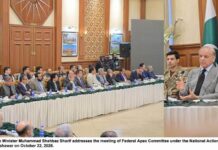
The package, announced during the Prime Minister’s interaction with representatives of the Area Development Council for 12 districts where emergency has been imposed, has generated renewed expectations among the people, particularly those living in the merged tribal districts and other terrorism-affected areas.
The tribal representatives, politicians and people said the development initiative had come at a critical time when Khyber Pakhtunkhwa was facing serious challenges of terrorism, unemployment, poverty, weak infrastructure and inadequate public services.
Haji Shaukat Ullah, Chairman of the 48-member Area Development Council representing the 12 emergency districts and former Governor of Khyber Pakhtunkhwa, termed the Prime Minister’s Rs160 billion package historic, saying it could provide fresh impetus to economic activity and development in some of the most deprived areas of the province.
He expressed the hope that the federal government’s intervention, coupled with improved administrative and security arrangements, would help restore peace and create an environment conducive to investment and economic activity.
The tribal elders and Maliks also welcomed the imposition of emergency in 12 restive districts and the Governor’s Rule in the province, saying that extraordinary constitutional measures were needed to effectively address the security and governance challenges confronting the people.
He assured the federal government of their full cooperation in its efforts to eliminate terrorism and transform Khyber Pakhtunkhwa into a peaceful and economically vibrant province.
He said the tribal districts had witnessed a severe wave of terrorism in recent months, which had adversely affected peace, education, health, businesses and socioeconomic activities.
He said tribal people had always stood by Pakistan and rendered unparalleled sacrifices in the fight against terrorism.
“The tribal people have endured deep wounds, but their commitment to Pakistan has never diminished,” he said, adding that the Prime Minister had acknowledged the sacrifices of tribal elders and their deep-rooted affiliation with the country.
Shaukat Ullah said the tribal districts were blessed with considerable mineral and other natural resources, while their terrain and climate offered significant potential for olive cultivation, livestock and other agro-based activities.
He said proper investment in these sectors could generate thousands of employment opportunities for local youth, reduce poverty and provide sustainable sources of income to communities that had suffered from decades of instability.
He also appreciated the federal government’s commitment to addressing the shortage of wheat flour in the province and welcomed the Prime Minister’s resolve to ensure availability of essential food items at affordable prices.
He said strict action should be taken against those involved in artificial hoarding and profiteering, adding that effective administrative measures could provide immediate relief to ordinary consumers.
Shaukat Ullah expressed the hope that the long-standing sense of deprivation among the tribal population would gradually come to an end and that the new development initiatives would usher in an era of peace, economic opportunity and prosperity.
In KP, the scale of the development challenge in KP is also reflected in labour market statistics that requires attention of the KP Governor.
According to the Labour Force Survey 2024-25, Khyber Pakhtunkhwa recorded the country’s highest unemployment rate at 9.6 percent, compared with 7.3 percent in Punjab, 5.5 percent in Balochistan and 5.1 percent in Sindh. This showed the poor education policies of PTI Government.
The figures underline the urgency of creating productive employment opportunities, particularly for young people, who constitute a major segment of the province’s population.
Experts believed that investment in education, infrastructure, industry, tourism, agriculture, minerals, information technology and small and medium enterprises can help absorb the growing labour force while simultaneously strengthening the provincial economy.
Former MNA Shahjee Gul Afridi, while welcoming the Prime Minister’s development package, said the government’s strong resolve to eliminate terrorism was equally important for the province’s future.
He said all eight merged tribal districts, along with Dera Ismail Khan, Bannu, Lakki Marwat and Tank, had been severely affected by terrorism, which had disrupted routine life and hindered development.
He questioned what he described as the silence of the PTI leadership over the deteriorating security situation and stressed that peace was a prerequisite for development.
He said people and police were being martyred in KP during terrorists attack while the non functional CM Sohail Afridi was standing on container for politcal gains.
He said PTI Govt failed to eradicate terrorism and strengthen counter terrorism department as well as police despite it received about Rs. 800 billion under anti terrorism share in NFC award.
Afridi welcomed the Prime Minister’s directions for strengthening and making the Counter Terrorism Department (CTD) more effective and for completing Safe City projects in Khyber Pakhtunkhwa on a priority basis.
He also welcomed the assurance that the federal government would provide the necessary resources to eliminate terrorism and remove hurdles in the completion of development schemes.
He stressed the need to empower the Tribal Council to play a meaningful role in development affairs and speedy provision of justice in the merged districts.
Referring to education indicators, he said a major challenge confronting the province was the large number of out-of-school children.
According to figures cited from the Benazir Income Support Programme (BISP) and other education-related assessments, millions of children remain outside the formal education system in Khyber Pakhtunkhwa, particularly girls and children living in remote and economically disadvantaged districts.
The situation is particularly concerning in several remote areas, where poverty, lack of educational infrastructure, difficult terrain and social constraints combine to keep children away from classrooms.
Such educational deprivation, experts cautioned, can have long-term consequences for human development, social stability and economic growth.
They said the development package should therefore place special emphasis on schools, vocational training, girls’ education and employment-oriented skills so that young people can become active participants in the province’s economic transformation.
The financial position of public sector universities also highlights the broader challenges confronting the province’s education sector.
Higher education was also marred with poor investment during 13 years long rule of PTI in Khyber Pakhtunkhwa where most of public sector universities were facing financial problems.
A fiscal analysis of KP universities for 2021-2024, prepared by the Governor’s Secretariat, showed that universities recorded surpluses of Rs4.113 billion in 2021 and Rs3.938 billion in 2022, but the projected surplus declined sharply to Rs545 million in 2023-24.
The analysis attributed the decline largely to over-recruitment, inflation and weak financial management.
Despite reforms, universities recorded only modest revenue growth, while federal grants to KP’s public universities increased steadily, reaching Rs10.954 billion in 2023.
The grants were aimed at improving infrastructure, research, faculty development and student support.
The figures indicated that sustained investment, combined with better financial management and institutional reforms, will be essential to strengthen the province’s higher education system.
Incomplete projects, missed opportunities
Several incomplete development projects also demonstrate the need for effective execution and monitoring.
The Arbab Niaz International Cricket Stadium in Peshawar, a major sports infrastructure project, remains incomplete despite substantial expenditure and increases in construction costs.
Similarly, work on the Kalam Sports Stadium in Swat has yet to begin, highlighting the gap that can emerge between development planning and implementation.
Political representatives and civil society members have therefore stressed that the success of the Rs160 billion package will ultimately depend not only on the allocation of funds but also on transparent utilisation, timely completion of projects and effective monitoring.
Shahgee Gul Afridi said the Prime Minister’s assurance of federal support for terrorism-related challenges and development projects had created hope among people of the affected districts.
He said the province needed a comprehensive strategy combining security, infrastructure development, education, employment and investment.
“Peace and development are interlinked. Without peace, investment cannot flourish, and without economic opportunities, sustainable peace cannot be guaranteed,” he said.
Former minister Wajid Ali Khan also welcomed the Prime Minister’s development package, saying it could play an important role in changing the destiny of the people of Khyber Pakhtunkhwa.
He alleged that maladministration and corruption during the previous PTI provincial government had weakened institutions, discouraged investment and slowed development.
He referred to Rs 100 billion alleged irregularities in drinking-water projects and the reported Rs37 billion Kohistan corruption scandal, calling for greater transparency and accountability in the utilisation of public funds besides contracts were awarded to favourites.
The Rs160 billion package has consequently raised expectations that Khyber Pakhtunkhwa can move from a cycle of insecurity and underdevelopment towards sustainable economic growth.
For the people of the merged districts, the package carries particular significance as they continue to seek better roads, schools, hospitals, employment, markets and access to justice after years of conflict and deprivation.
The province’s vast mineral potential, tourism destinations, agricultural resources, livestock sector and young population offer considerable opportunities for economic transformation if supported by peace, infrastructure and effective governance.
For ordinary citizens, however, the real test will be visible on the ground as a functioning school instead of an empty building, a completed road instead of a stalled project, a hospital equipped to treat patients, reliable electricity and water, and a job that enables a young person to build a future at home.
The Prime Minister’s Rs160 billion package, therefore, is being viewed not merely as a financial allocation but as an opportunity to reconnect development with the aspirations of millions of people across Khyber Pakhtunkhwa.
Its successful implementation, coupled with restoration of peace and improved governance, could help turn the province’s considerable human and natural resources into engines of sustainable growth and open the gate to a new era of prosperity and development.