Intl Mountains Day: Pakistan needs digital projection to harness mountains wealth for economic prosperity
PESHAWAR (APP): As dawn broke across Pakistan’s beautiful north on International Mountains Day, sunlight spilled over the snowy crowns of Swat, Chitral, Kohistan and Khyber which gives an annual reminder of the country’s immense but underutilized mountain wealth.
Seminars, walks and workshops were held in major cities of Khyber Pakhtunkhwa (KP), where experts and mountaineers emphasized not only the ecological importance of these towering mountain ranges but also the human stories of communities battling climate change, dwindling glaciers, and economic hardship.
But every speech and banners slogans were a recurring message that Pakistan is sitting on a goldmine of mountain tourism and unlocking it requires one thing above all else is digital projection imperative for economic gains.
This year’s theme of international mountains days was “Glaciers matter for water, food and livelihoods in mountains and beyond,” resonates deeply in Pakistan which is home to 61% mountainous terrains and some of the planet’s tallest and most spectacular peaks of over 8000 meters height.
The world’s second tallest legendary K2 (8,611m), Nanga Parbat (8,126m), Gasherbrum I, Broad Peak and Broad Peak Middle in Pakistan dominate global mountaineering lists. Pakistan hosts five of the world’s 14 peaks above 8,000 meters, and more than 108 peaks above 7,000 meters, making it one of Earth’s most concentrated high-altitude regions.
Beyond the giants of Karakoram and Himalaya, Khyber Pakhtunkhwa alone boasts over 1,130 named mountains, including Tirich Mir (7,708m) which is the world’s highest peak outside the Himalaya-Karakoram, Boni Zom (6,542m) in Chitral and Falak Sar (5,957m) and Mankial (5,650m) in Swat, Malka Parbat (5,290m) in Kaghan. Miranjani (2,992m) and Mukeshpuri in Galyat Abbottabad and Koh-e-Suleman (3,487m) in DI Khan.
For global adventurers and mountaineers, these names evoke awe while for locals, they represent livelihoods, culture, employment and identity in Khyber Pakthunkhwa’s Swat, Chitral, Dir, Malakand, Buner and Shangla.
“We must show the world what mountain treasures we have through digital tourism,” says Abu Zafar Sadiq, President of the Alpine Club of Pakistan. “Pakistan is one of the most attractive destinations for mountaineering and adventure sports but unfortunately we have not told our story being a land of mountains to the world.”
Speaking to APP, he called for digital tourism portals, online climbing permit systems, virtual tours, and global social media campaigns, arguing that these tools are essential to transform Pakistan’s mountain beauty into economic opportunity. “Online booking alone can change everything,” he said. “Make it easy, make it digital and the world will definitely come.”
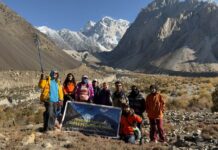
One of the most powerful human stories this year came from the breathtaking Tirich Mir Valley in Chitral, where KP Cultural and Tourism Authority (KP-CTA), in partnership with the Tirichmir Backpackers Club, successfully completed the second phase of the Tirich Mir trekking revival expedition.
Professor Dr Muhammad Naeem, former Chairman Economics Department told APP that Pakistan’s economic woes can largely be addressed by promoting mountain tourism. He said Pakistan’s travel and tourism sector is expected to generate over $4 billion in revenue by 2025. He said the tourism industry is set to grow at an annual rate of 6.75% from 2025 to 2029, potentially reaching a market volume of $5.53 billion by the end of 2029.
He called for improved road infrastructure in mountain regions, establishment of camping pods, and expansion of tourism police and training of tour guides. The KP Govt’s project of providing loans on easy terms and conditions to community for construction and renovation of rooms for stay of tourists in mountains areas especially at Kalam, Naran Kaghan, Kumrat and upper Chitral will turn Malakand and Hazara division a hub of mountaineers and adventure sports enthusiasts.
According to KP Culture and Tourism Authority, twenty trekkers both local and national adventurers and mountaineers, took part in the Trichmir summit held in August this year. Mountaineers Sirbaz Khan and Abid Baig, both from Gilgit-Baltistan, made history by hoisting Pakistan’s flag on Tirich Mir’s summit.
For Sirbaz, the moment was emotional and said “this dream was possible only because of the support we received from Govt,” he said. “With Tirich Mir, we have now scaled the highest peaks of all three great ranges ie Hindu Kush, Himalaya and Karakoram.”
Sirbaz believes that Tirich Mir’s surrounding peaks can become Pakistan’s next big attraction. “Porters, climbers, and adventurers from across the world will come here if we highlight these unique treasures through digital media before internationally,” he said. “Chitral can become the next global basecamp for mountain tourists,” he reiterated.
According to KP Tourism Authority over 20.6 million domestic tourists and 7,600 international tourists visited KP last year while in the first five months of 2025 alone, nearly 300,000 domestic and 2,500 foreign tourists arrived, showing 18.5% increase over the previous year.
“These are not just numbers but it shows that Pakistan, especially KP is very beautiful, and ready for the world to explore.” The proposed mega projects planned are cable cars, integrated tourism zones (ITZs), and Eco-Tourism.
To meet the growing demand of tourists, the government is investing heavily by planning to construct cable car from Madaklasht (Chitral) to Kumrat (Dir Upper) which is set to be one of the highest and longest in the world besides expecting annual visitors of 1.2 million to Malakand division.
Officials said these investments mark the beginning of KP becoming a global mountains tourism powerhouse besides nullifying negative perception. On this International Mountains Day, Abu Zafar said that our message is clear that mountains are our inheritance but only digital visibility can unlock their true potential.
From the windswept peaks of Chitral to the green valleys of Kalam Swat, a new chapter is beginning that resemblance of technology, tourism, culture, and climate resilience are vital for a more prosperous mountains future in Pakistan.