A childhood stolen: One family’s polio pain, a warning to others
PESHAWAR (APP): As dusk swallows the jagged silhouette of the Khyber mountains, 75-year-old Jamshed Ali slowly pushes his son’s wheelchair toward a dusty playground along the banks of the River Kabul in Nowshera as each turn of the wheel echoing a lifetime of regret.
There, in a swirl of laughter and drifting dust in relatively pleasant evening amid sunset, children of nearby neighborhoods sprint after a worn-out football, their joy unrestrained, their futures unwritten unaware that just a few feet away, a silent heartbreak watches from the sidelines, aching to run with them but forever held back.
Seated in a wheelchair, 32-year-old polio victim Abid Ali leans forward, eyes locked on the game. His arms stretched instinctively toward the ball each time it rolls near, as if muscle memory still recalls a childhood that never fully came to be.
“Sometimes my sweet son tries to catch the ball,” Jamshed says, his voice trembling. “And when he loses balance and falls it feels like my heart falls with him.”
Abid was only three years old when a fever changed everything. “It started with pain in his limbs,” Jamshed recalled, gripping the wheelchair handles. “Within days, he couldn’t stand. The doctors told us it was polio. Both his legs stopped working.”
He pauses, weighed down by memory and regret.
“We didn’t vaccinate him,” he admitted quietly. “We believed the rumours and negative propaganda—the lies about the polio vaccine. That guilt follows me every single day since he was attacked by polio virus.”
Abid, despite his physical limitations, has never lost his spirit. But his father lives with a burden that grows heavier with time.
“I would give anything to go back and make a different choice,” Jamsheed added. “No parent should have to carry this kind of heavy psychological burden and regret.”
Abid’s story is not an isolated one in Khyber Pakhtunkhwa. Across Khyber Pakhtunkhwa, misinformation, negative propaganda and mistrust continue to hinder anti polio vaccination efforts, leaving children vulnerable to a disease that is both preventable and irreversible.
Health officials recently confirmed a new case in Torghar district, where a 12-month-old boy tested positive for wild poliovirus type-1 (WPV1).
Pakistan reported 31 polio cases in 2025, including 19 from KP alone—figures that experts described as deeply alarming.
“Polio is a highly contagious and irreversible disease and can spread to others children,” warned Dr. Saimullah, head of the children’s department at Mardan Hospital. “Vaccination is the only effective protection we have against polio.”
He stressed that the oral polio vaccine is safe, widely tested, and lifesaving.
“Vaccines prevent up to three million deaths globally every year,” he said. “Imagine how many children like Abid we could save if misinformation and negative propaganda didn’t stand in the way.”
In many underdeveloped and low-literacy areas, false narratives about vaccines continue to spread, often fueled by fear and lack of access to reliable information.
“In Abid’s case, misinformation and negative propaganda robbed him of a childhood,” Dr. Saimullah added. “And it robbed his father of peace.”
Now, Jamshed has turned his grief into a mission to create awareness against polio.
“I talk to parents whenever I can,” he said. “I tell them my story. I beg them don’t make the same mistake. Don’t wait until it’s too late.”
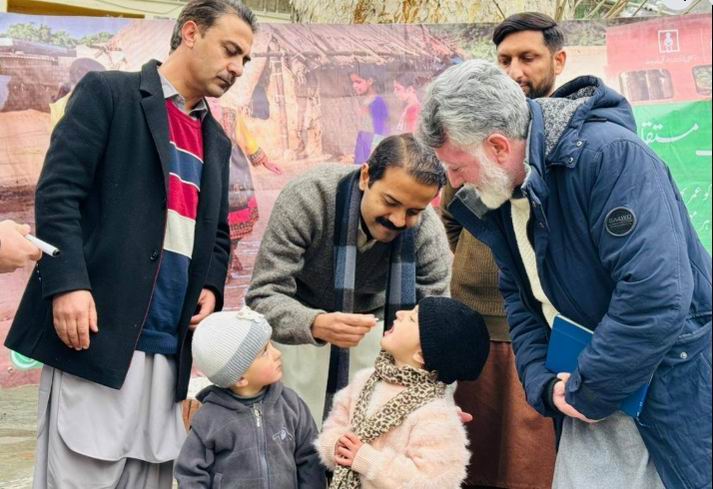
Despite setbacks, health authorities insisted there is still hope to wipe out polio. The nationwide polio vaccination campaign launched on April 13, 2026 aims to immunize over 45 million children under five years of age.
More than 400,000 vaccinators are going door-to-door, administering vaccines and Vitamin A supplements.
In Khyber Pakhtunkhwa alone, around 6.5 million children across all 38 districts are being targeted.
Officials from the Emergency Operations Centre (EOC), UNICEF, and WHO have reaffirmed their commitment to eliminating polio, one child at a time.
Provincial Health Minister Khaliqur Rehman has also taken a firm stance, warning of strict action against parents and guardians particularly government employees—who refuse vaccination.
“Neglecting vaccination doesn’t just endanger one child,” he said at a recent briefing. “It puts entire communities and future generations at risk.”
Back in Dheri Ishaq village, the game winds down as dusk settles in. Children drift home, their laughter fading into the evening air.
Abid watches until the very end.
Jamsheed gently turns the wheelchair around and begins the slow journey back home, carrying a weight far heavier than his years.
“If my story can save even one child,” he says softly, “then maybe my regret will mean something.”
For families like his, the fight against polio is no longer just a public health campaign rather it is deeply personal, etched in loss, and driven by the hope that no other child will have to watch life from the sidelines.