Social Welfare Department launches SOPs for Guardianship
PESHAWAR (APP): Advisor to the Governor Khyber Pakhtunkhwa for Education and Social Welfare, Dr. Aamer Abdullah here Thursday said the protection, education, development and dignity of children are a shared responsibility of the government and society.
He emphasised that every child must be provided with a safe environment free from abuse, exploitation, violence and neglect, along with equal opportunities to realise their potential. Protecting children’s rights is not merely a legal or social obligation but the foundation of a safer and better future.
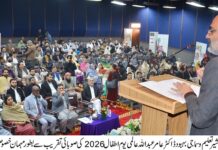
He expressed these views while addressing the provincial-level World Children’s Day 2026 event as chief guest, organised by the Khyber Pakhtunkhwa Child Protection and Welfare Commission at the Sahibzada Abdul Qayyum Auditorium, Radio Pakistan Peshawar.on Thursday.
The event was attended by Secretary Zakat, Ushr, Social Welfare, Special Education and Women Empowerment Mutasim Billah Shah; Additional Chief Child Protection Commission Ejaz Muhammad Khan; UNICEF representative Muhammad Usman Abdi; Helvetas Pakistan representative Shazia Hina Durrani; Child Protection Officer Bushra Ajmal; representatives of government departments, development partners and civil society organisations, as well as children and their parents.
During the event, the Standard Operating Procedures (SOPs) for guardianship were formally launched. Furthermore, the Terms of Reference (ToRs) for mutual cooperation were signed between the Commission and renowned social worker and religious scholar Waliullah Maroof, following his designation as Khyber Pakhtunkhwa Child Protection Brand Ambassador. The initiative aims to trace missing and separated children and facilitate their reunification with their families.
Addressing the gathering, Dr. Aamer Abdullah said that the Khyber Pakhtunkhwa Child Protection and Welfare Act, 2010, along with its reform amendments introduced in 2022, provides a strong legal foundation for child protection. However, he stressed that legislation must be accompanied by effective implementation, enhanced institutional capacity and coordinated collaboration among relevant departments.
He appreciated the Commission’s efforts to strengthen the child protection system at the district level, improve service delivery and promote public awareness. He added that, in addition to the existing 12 Child Protection Units, five more units were being added to expand the network.
According to the figures shared with the Adviser, the Commission has so far reached 35,764 children, including 21,345 boys and 12,664 girls. It has provided legal assistance to 7,890 children and families, resolved 3,456 cases involving missing children, assisted 456 runaway children, safely reunited 678 children with their families, reintegrated 345 children into their families, schools and normal lives, and provided care to 432 children in need of support. In addition, more than 40 children have been provided with a permanent family environment through formal guardianship arrangements.
Describing the launch of standardised guardianship SOPs as an important step towards making the child care and guardianship system more organised, transparent and effective, Dr. Abdullah said that the SOPs, developed with technical support from UNICEF, would clearly define the procedures and responsibilities of relevant institutions while ensuring that the best interests of children remain paramount in every decision.
He also appreciated the development of an online guardianship database and portal, saying that the digital system would facilitate the submission and processing of guardianship applications, their referral to relevant authorities and the monitoring of case progress. This, he added, would enhance transparency and improve institutional coordination.
Appreciating the services of Child Protection Brand Ambassador Waliullah Maroof, Dr. Abdullah said that over the past five to six years, he had played a significant role in reuniting thousands of children with their families after years of separation. Some cases had even been resolved after nearly 30 years through DNA analysis.
Waliullah Maroof had been performing work equivalent to that of an entire institution single-handedly, helping reunite separated family members in several foreign countries. His efforts had also received coverage in international media. The Adviser said that the Commission needed such an active and committed individual to promote child protection and raise public awareness about its activities. He added that Waliullah Maroof would provide these services on a voluntary basis, without any remuneration.
The Adviser on Social Welfare said that institutional measures alone were not sufficient to ensure child protection, stressing the importance of active participation by families, communities, educational institutions and civil society. He noted that public cooperation was essential for the timely reporting of missing children, tracing their families and ensuring their safe reunification.
He urged all relevant institutions to strengthen their coordination with the Commission to ensure timely resolution of issues faced by children and the provision of necessary protection and support.
Dr. Aamer Abdullah also welcomed Helvetas Pakistan’s initiative to provide technical and vocational skills training to 800 children. He directed the Social Welfare Department to further expand cooperation with development partners, emphasising the need to improve the quality of child care and protection services and ensure their access to a greater number of deserving children.
Appreciating the stage performances presented by children during the event, the adviser said that such activities effectively highlighted the challenges faced by children, their rights and the positive and negative attitudes prevalent in society regarding their protection.
He reaffirmed his commitment to strengthening the efforts of the Commission and all relevant institutions to make the child protection system more effective.He stressed the need to enhance the capacity of district-level Child Protection Units, improve coordination among the police, health, education, district administration and social welfare departments, and promote public awareness and preventive measures to ensure that no child is exposed to insecurity, exploitation or neglect.
He distributed shields among officials of the Social Welfare Department and representatives of partner organisations in recognition of their contributions. Gifts and kits were also distributed among the children.