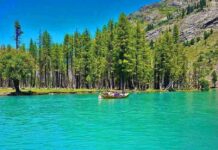
Swat’s majestic winter landscape turns Mahudhand lake into nature’s classroom
SWAT (APP): As cool mountain breezes herald the arrival of winter across the emerald valleys of Swat, thousands of tourists are pouring into the region, turning its misty mountains, roaring streams and pine-scented forests into a bustling theatre of tourism, adventure and human connection.
From Kalam and Bahrain to Madyan, Mahudhand lake, Osho valley, Jazz Banda and Malam Jabba, the scenic valleys are alive with visitors eager to experience the changing colours of nature.
Green hills are gradually giving way to winter shades, clouds drift lazily across mountain slopes, and occasional sunshine breaks through the mist to create breathtaking scenes.
For many visitors, it is a memorable escape from the routine of city life in Khyber Pakhtunkhwa. For local communities, however, the arrival of tourists during winter means something far more important with opportunities for generating income, employment and renewed hope.
Along the winding tracks connecting Kalam with Osho Valley, the rhythmic clip-clop of horses echoes through forests still damp from recent rains.
Local horse riders, many of whom depend heavily on tourism to support their families, are witnessing a welcome increase in business.
“When the sun appears after rain and rainbows stretch across the mountains, everything shines,” said local guide Ehtisham Khan, pointing towards the cloud-kissed peaks of Kalam.
For tourists, a horseback ride through these landscapes feels like travelling through a dream. The trails leading towards Mahudhand lake, renowned for its crystal-clear waters and colourful boats, have emerged as one of the favourite attractions for visitors seeking an intimate encounter with nature.
The journey itself is part of the adventure and thrills. Horses move slowly through pine-scented forests and mountain tracks while visitors stop repeatedly to admire waterfalls, streams, mist-covered slopes and distant peaks.
The tourism boom has also opened new opportunities for local photographers and movies makers in Swat. At scenic viewpoints, forest trails and popular tourist spots, photographers patiently wait for the perfect moment when sunlight pierces through the clouds, a rainbow appears over the mountains or a family poses against the dramatic backdrop of the valley.
For many visitors, these photographs are more than souvenirs; they are memories to be carried home and shared with friends and relatives.
Shehryar Khan, a local photographer, said the past week had been among the busiest periods of his career.
“People want something special to remember,” he said. “A photograph with a horse emerging through the rainbow or sunlight breaking through the clouds creates lasting memories they cannot find anywhere else.”
With smartphones and social media turning almost every tourist into a potential promoter, these images are travelling far beyond Swat. Visitors share photographs and videos on Facebook, Instagram, TikTok and other digital platforms, indirectly advertising the valley to thousands of potential tourists.
“Kalam and Malam Jabba are bursting with colours,” said Omar Khayam, a tourist from Nowshera at Mahudhand lake.
“Everywhere I look, I want to take photographs and share them with my friends and relatives back home through digital platforms.”
The growing influx of tourists is also breathing new life into the local economy in Swat where hotels, guesthouses, restaurants, transport operators, horse riders, photographers, shopkeepers and roadside vendors are all benefiting from the increased flow of visitors.
For families running small businesses, a busy tourist weekend can make a significant difference to their monthly earnings.
“I came here with my family to enjoy Kalam’s natural beauty, experience the winter breeze and taste its famous trout fish,” said Qaiser Khan, a visitor from Wapda Town, Peshawar.
He said that improved road connectivity had made travelling to Swat much easier, particularly after the opening of the Swat Motorway, which has brought the scenic valley closer to major urban centres such as Peshawar and Islamabad.
For adventure lovers, Swat offers much more than sightseeing. Malam Jabba is famous for attracting skiing enthusiasts, while paragliding in Kalam and boating at Mahudhand lake provide visitors with opportunities to experience the mountains from the air and water.
Waterfalls, hiking trails, mountain tracks and opportunities for rafting further enhance the valley’s appeal, particularly among younger tourists seeking experiences that can be shared instantly on social media.
The hospitality sector is also feeling the impact. Hotels and guesthouses in Kalam and Malam Jabba are witnessing strong demand, with many accommodation facilities operating at or near full capacity during peak weekends.
At the heart of Upper Swat’s attraction is Mahudhand National Park, a biodiversity-rich destination surrounded by alpine meadows, forests, wildlife and diverse bird species.
Visitors can explore hiking routes leading towards Osho and Kalam peaks while enjoying the cool mountain climate and panoramic views.
The surrounding forests offer an equally enchanting experience. Layers of greenery, drifting mist and distant snow-capped mountains create a landscape that appears to change every few minutes as clouds move across the valleys.
For tourists accustomed to crowded urban centres, the silence of these forests is itself an attraction.
Tourism officials see the current surge as an golden opportunity not only to promote Pakistan’s natural beauty but also to create sustainable economic opportunities for communities living in remote mountainous areas.
Officials of the Khyber Pakhtunkhwa Tourism and Culture Authority told APP that several initiatives are being pursued to improve accommodation, promote community-based tourism and expand access to relatively unexplored destinations.
To promote winter tourism, camping pods have been established at Bamborat Kalash Valley in Chitral, Shaheed Sir in Allai, Battagram, Mahban and Malka in Buner to provide tourists with comparatively affordable accommodation.
Officials said around 10 new tourist sites had also been identified for the establishment of camping pods, including Jarogo Waterfall, Solatar and Kalam in Swat; Lashkargaz, Broghal and Solarspot in Chitral; Kumrat in Upper Dir; Alpuri in Shangla; Samana Top in Hangu; and Larum Top and Bin Shahi in Lower Dir.
The plans also include the establishment of three new ski resorts in Kaghan, Chitral and Swat to attract foreign tourists and adventure-sports enthusiasts.
Four new hill stations two in Kaghan and one each in Chitral and Abbottabad are also proposed to reduce pressure on established destinations such as Kalam, Nathiagali and Kaghan.
Officials are also exploring ways to diversify winter tourism throughout the year.
The climate of Naran and Kaghan is considered suitable for tulip cultivation, with plans for tulip gardening expected to create another source of income for local growers. Growers could potentially earn around Rs100,000 from one kanal of tulip production.
The proposed Battakundi-Lalazar chairlift project is another initiative under consideration to further enhance the region’s tourism infrastructure.
Such projects, if implemented effectively, could help transform tourism from a largely seasonal activity into a more sustainable year-round economic sector.
For now, however, it is the simple magic of nature that remains Upper Swat’s strongest attraction.
A sudden rainbow after rain, sunlight filtering through clouds, roar of a waterfall, thrill of paragliding over a valley, a quiet boat ride on Mahudhand Lake or the first signs of snowfall all combine to create experiences that visitors carry back with them.
But behind every photograph and every tourist memory is a local story carrying lifelong memories.
It is the horse rider waiting beside a mountain trail, a photographer watching the sky for the perfect light, the hotel worker preparing another room, the restaurant owner serving trout to a family, the driver navigating winding roads and the roadside vendor hoping for one more customer before a cool sunset.
In Upper Swat, therefore, tourism is not merely about scenery but about people whose lives are increasingly intertwined with the mountains that surround them.
As winter settles over Kalam and neighbouring valleys, every ray of sunlight breaking through the mist tells two stories at once as one of nature’s breathtaking splendour and the other of communities finding hope and livelihood in the visitors drawn to one of Pakistan’s most spectacular mountain destinations.