Qehwa: Peshawar’s timeless antidote to screen time
PESHAWAR, (APP) : As smartphones glow late into summer nights and social-media notifications compete for attention, an older form of connection still thrives in the heart of Peshawar.
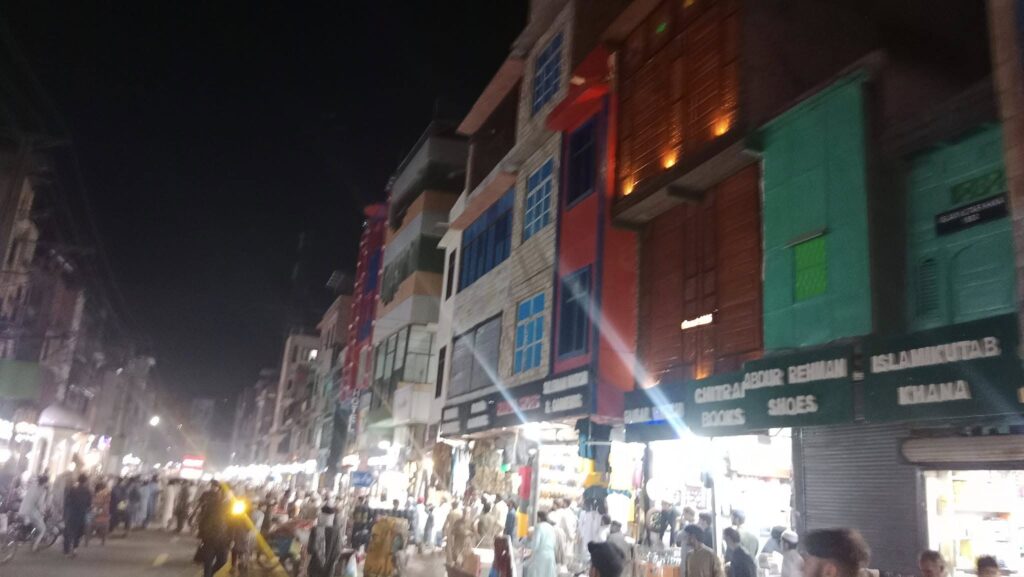
In the narrow lanes of bustling Qissakhwani Bazaar, the clink of tea glasses, the aroma of cardamom and green tea, and the rise and fall of conversation create an unmistakably old-fashioned, timeless soundtrack.
Known as the street of storytellers, Qissakhwani has for centuries been a historic place where travelers, traders, intellectuals and ordinary citizens gathered to exchange news and stories over steaming cups of qehwa (green tea).
Even on a hot Sunday, traditional qehwa khanas remained busy from morning until late at night where families and friends gathered around low wooden charpayees ( beds) and tables, talking politics, culture, sport, business and everyday life.
For many, Peshawari qehwa is more than a drink but a cultural ritual, a social bond and a link to memories that predate smartphones, television and modern political life.
For many visitors, the Qissakhwani experience begins with delectable cusines. The bazaar remains renowned for chapli kabab, mutton karahi, paye, fried fish, chicken roast, Kabuli pulao and other traditional dishes. After a hearty meal comes qehwa being light, aromatic and traditionally regarded as best for digestion.
“Before close of summer vacations of my children, I along with family came from Nowshera to enjoy the mouthwatering chapli kabab with Peshawari qehwa at Qisakhwani,” said Fatima Fayaz, a lecturer of Statistics while talking to APP.
“I have visited many cities of Pakistan, but the Peshawari chapli kabab along with Qissakhwani bazaar’s qehwa has impressed me the most,” she said, adding for families, these ancient qehwa khanas are best places to spend some times in its soothing environment.
“Whenever I come to Peshawar, I try to visit Qissakhwani to enjoy its delectable cuisine and famous qehwa,” she said.
“Peshawari qehwa gives warmth to the body and is traditionally considered helpful for flu and digestive problems,” she added.
“But perhaps its greatest benefit that it gives people a reason to sit together and divert eyes from mobile screens.”
The continued popularity of qehwa is striking in an era when so much social interaction takes place through screens.
Yet inside qehwa khanas, people still put their phones aside long enough to talk to the person sitting opposite them.
Fazl Rehman, owner of Mohmand qehwa khana at Shahwali Qatal street at Qisakhwani, said the this tradition was part of his family identity.
“I inherited the business from my father as school boy and have been proudly associated with it for the last 57 years,” he told APP.
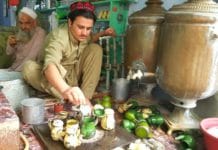
“Making qehwa is my passion, which I inherited from my father in 1969 when I was a primary school child, and my son has also joined us, five years back,” Rehman said asking waiter to serve it to customers sit in wooden hanging charpayees.
According to him, most customers still prefer traditional qehwa. Milk-based qehwa, locally known as sheen da payo, is particularly popular at parties and special gatherings.
“Qehwa culture is still alive despite social media addiction. People come here and swap tales of culture, music, art, politics and traditional food while enjoying the famous cuisine and qehwa till late night,” he said.
His memories pointed to another role once played by the qehwa khana that was the neighborhood newsroom before there were smartphones.
These qehwa khanas has played its pistive part in people awakening during independence movement for Pakistan, Rehman said and added that tea stalls became important centers of political discussion after creation of Pakistan.
He recalled debates surrounding the election between Fatima Jinnah and Gen. Ayub Khan, 1965 Pakistan-India war, 1974 OIC Lahore Summit and major sporting and cultural events, including Pakistan’s 1992 cricket world cup’s victory.
Before breaking news arrived instantly on a mobile screen, these tea houses were among the places where information traveled fastest.
One person brought news from another part of the city while another supplied a political interpretation and a third repeated something heard from a traveler.
Stories moved from table to table, acquiring new voices along the way at Qissakhwani. In that sense, these qehwa khana was never merely a place to drink tea but was a living social network.
From caravan route to cultural landmark, Qissakhwani lies in Peshawar’s historic centre, near landmarks such as Chowk Yadgar, Ghanta Ghar and Balahisar fort.
Its history is inseparable from Peshawar’s strategic position at the crossroads of South Asia, Afghanistan and Central Asia. For generations, traders and travelers stopped in the bazaar, exchanging stories of distant lands alongside merchandise and enjoyed its mouthwatering chapli kebab with qehwa.
At the height of its importance as a caravan and trading centre, merchants travelling from Delhi, Amritsar, Lahore, Kabul and Central Asia passed through Peshawar where commerce, trade and storytelling naturally converged.
Bakhtzada Khan, a research officer in the Archeology Department, said Qissakhwani’ s history was deeply connected with the antiquity of Peshawar culture itself.
He said the tradition of qehwa took root during the Afghan dynasties and the Mughal era, when rulers and communities developed a deep fondness for rich meat dishes, often savored alongside the fragrant warmth of qehwa.
“Thus, the unique tradition of storytelling and drinking qehwa became an integral part of Qissakhwani culture which is still continuing despite the social media onslaught,” he said.
The qehwa khana’ s physical character reinforced that communal tradition.
Low wooden beds and simple seating encourage groups to linger. Unlike many modern coffee shops, where customers may work on laptops or stare into phones, these spaces are designed around company and strengthen bonds of friendships.
The aroma of freshly prepared qehwa mingles with grilled meat and spices from neighboring food stalls. Waiters weave between tables as conversations rise and fall around them.
For visitors from elsewhere in Pakistan, the combination creates a distinctly Peshawari experience where food meets heritage.
While staying at Qissakhwani, the tourists can also explore historic residences associated with prominent families of the South Asian film industry, including ancestral homes of Bollywood legends Yousaf Khan alais Dilip Kumar, and the Kapoor family.
The ancestral residence associated with Prithviraj Kapoor, father of actor Raj Kapoor, remains among the area’s historic attractions. The ancestral home associated with Shah Rukh Khan’s family is also located in the historic neighborhood.
Together with traditional food and qehwa khanas, these sites give Qissakhwani an unusual blend of culinary, architectural and cultural tourism.
Visitors can also see the monument commemorating the 1930 Qissakhwani massacre, when British troops opened fire on peaceful protesters.
The white marble monument is a reminder that the bazaar’s history is not only one of commerce and hospitality, but also of political struggle and sacrifice for freedom.
The qehwa tradition has survived difficult periods that threatened the bazaar itself. Qissakhwani experienced a sharp decline in visitors when incidents of terrorism increased in 2001-2013 in Khyber Pakhtunkhwa that badly affected qehwa business.
Qissakhwani witnessed a sharp decrease in the arrival of tourists during this period when terrorists targeted this cultural hub of Peshawar and claimed so many precious lives, including ANP stalwart and senior minister Bashir Ahmed Bilour in 2012 and CCPO Malik Muhammad Saad Shaheed in 2007.
“However, despite terrorism incidents, our qehwa khana’ s doors remained opened for visitors,” Rehman
said.
“In spite of the economic losses caused by terrorism and later by COVID-19, traders continued their businesses even during those hard days when people were afraid to visit this ancient bazaar,” said another Qehwa seller, Omar
Khan.
He called for financial support from the Khyber Pakhtunkhwa government to preserve the centuries-old qehwa tradition, warning that the remaining Qehwa Khanas could otherwise disappear.
The future of qehwa is also tied to a much larger issue on the country’s dependence on imported tea.
Dr Abdul Waheed, Director of the National Tea and High-Value Crop Research Institute at the Pakistan Agricultural Research Council (PARC), said Pakistan was spending substantial revenue on import of tea despite its considerable potential to become self-sufficient in tea production.
“If we plant tea on an additional 2,000 hectares of land in northern KP and Punjab and invested in by private companies, we can meet 95 percent of our national tea demand,” he said.
He said the greater domestic production was needed to reduce dependence on tea imports, adding Pakistan had imported 2,258,000 kilograms of black and green tea, costing $596 million in 2022.
“We have the capacity for four million tea plants per annum. The main obstacle is finances and time. Farmers need to wait five to six years before the first picking.”
Waheed suggested declaring tea plants forestry crops so they would not be replaced by other tree species. He also recommended incentives such as interest-free loans during the gestation period, pointing to similar support mechanisms in China.
Shaukat Ali Khan, Chairman of the Central Organization for Tea Traders Khyber Pakhtunkhwa, said developing a domestic tea industry could reduce import dependence while creating another cash crop for farmers in suitable areas especially in Malakand and Hazara divisions.
Around Rs100,000 was being spent on every 50 kilograms of imported green tea, most of which came from Vietnam, he said.
“This amount could be saved by facilitating investors and farmers to cultivate green tea in upper KP, especially in Malakand and Hazara divisions due to their suitable climate for tea farming,” he said.
Green tea is already being cultivated at Shinkiyari in Mansehra, he said, but production remains low compared with people’s demand besides inadequate support of KP Govt.
He urged the provincial government to provide financial incentives to farmers for machinery needed for tea cultivation and harvesting, helping reduce the country’s foreign-exchange burden.
“The challenge is no longer simply keeping qehwa shops open. It is preserving the cultural ecosystem around them.”
“After enjoying qehwa and grilled fish at Qissakhwani, I came here to see the cultural heritage trail that covered about a 500-meter route from Ghanta Ghar to Gor Khatri and included restoration and preservation work on dozens of heritage buildings,” said Khurshid Khan, an employee of Pakistan Mineral Development Corporation arrived from Kewara Punjab.
He said the combination of traditional food cuisine and the heritage trail through Mohallah Sethian, where distinctive houses built by the Sethi family in the late nineteenth century remain, added to the area’s appeal.
He said such initiatives showed how heritage conservation, food and tourism can reinforce one another and create opportunities for employment of local communities.
But conservation experts and traders believed physical restoration needs to be matched through digital spotlights to attract foreign tourists.
Qehwa-making videos, digital walking tours, interviews with elderly storytellers, archival photographs and documentaries could introduce Qissakhwani to a generation that may otherwise encounter it only through a phone screen.
The technology that pulls people apart could, in other words, become a tool for bringing them here.
As night settles over Qissakhwani, the bazaar does not fall quiet as qehwa continues to pour into small glasses at the bazaar where young men debate politics, elderly customers recalled an older Peshawar while families share meals besides travellers photograph the historic surroundings.
A shopkeeper explained how his father taught him to prepare green tea inherited the art to his son while some customers check their phones between conversations and.others photograph their food and post it online.
But eventually, many put the phones down and the conversation resumes. That may be the enduring strength of Peshawar’s qehwa tradition. It has never depended solely on the beverage but its real ingredient is human
company.
For centuries, travellers arrived in Qissakhwani carrying stories from distant places. Today, visitors arrive carrying smartphones capable of connecting them instantly with almost anyone in the world.
Yet the old ritual remains at Qisakhwani where a cup of hot qehwa is placed before the visitor and friends gather around a wooden hanging bed besides families share food and strangers exchange stories even today.
And for a while, the world’s oldest form of communication where people simply talking to one another takes centre stage.
In a rapidly digitizing society, Qissakhwani’s qehwa khanas offer a quiet reminder that some traditions survive not because they resist change, but because they continue to satisfy something technology cannot fully replace especially the human need to sit together, share a meal, exchange stories, strengthen bond of love and affection.