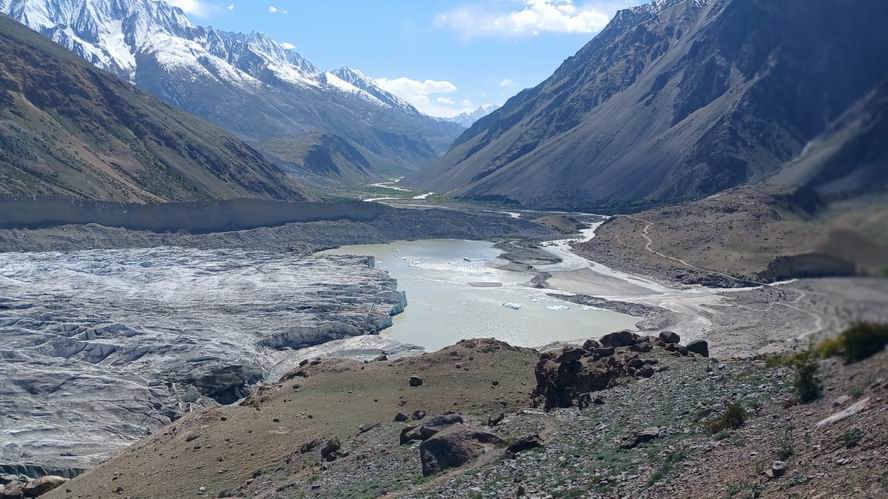
How 200 Vehicles a Day could Generate 40,000 Tonnes of Dust Annually – By: Hamid Ahmad
The Hidden Environmental Cost of The Chitral-Mastuj Road
The Dust We Don’t See, But Nature Does:
Nestled in Pakistan’s Hindu Kush and Hindu Raj Mountains, the Chitral–Mastuj valley is renowned for its spectacular landscapes, glacier-fed rivers, fertile biodiversity of global significance, and fragile sub-alpine and alpine ecosystems. Yet beneath this breathtaking scenery lies an overlooked environmental challenge, the dust generated by traffic on the largely unpaved, poorly maintained and a decade long under construction Chitral–Mastuj road.
While dust clouds trailing vehicles may appear to be only a temporary nuisance, however their cumulative environmental and climatic impacts can be enormous. Engineering estimates based on internationally recognized emission-factor methodologies suggest that this 110-kilometre unpaved road could be producing approximately 40,000 tonnes of airborne or fugitive dust every year, including nearly 9,600 tonnes of respirable PM₁₀ particulate matter.
Although these figures represent preliminary modeled estimates rather than field measurements, they provide an important perspective on how transportation infrastructure can influence mountain ecosystems, public health, agriculture, and even stability/health of fragile ecological components like glaciers.
Pakistan ranks high on environmental poverty due to factors like climate change, land degradation, deforestation, water scarcity, uncontrolled emissions, high population growth rate etc. Environmental poverty, where environmental degradation reduces livelihoods, health, and resilience, is an increasing challenge in Pakistan, particularly in climate-vulnerable mountain regions such as Chitral. Local communities depend heavily on agriculture, orchards, livestock, and glacier-fed water resources, making their livelihoods closely tied to ecosystem health. Dust pollution from the unpaved Chitral–Mastuj road can intensify environmental poverty by degrading air quality, reducing crop and rangeland productivity, accelerating glacier melt and increasing health expenditure burden.
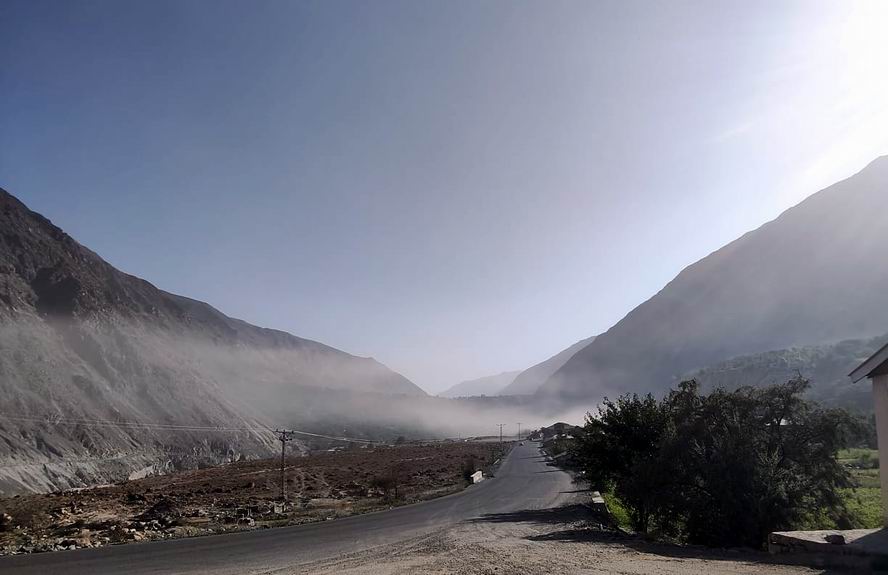
Understanding the Road and Traffic
The Chitral–Mastuj corridor stretches approximately 110 kilometres through one of Pakistan’s most environmentally fragile mountain landscapes. The road traverses a dry temperate valley characterized by loose sandy-silty soils, extensive glacial deposits, steep mountain slopes, and sparse vegetation, all of which make the terrain highly susceptible to dust generation. Annual precipitation is relatively low, averaging only 400–450 millimeters, with much of it falling as snow between December and March. During the long, dry summer season, prolonged periods without rainfall leave the unpaved road surface extremely vulnerable to disturbance by passing vehicles.
The road remains predominantly unpaved and serves as the principal transportation artery linking Lower and Upper Chitral. On average, around 200 vehicles use the corridor each day, travelling at typical speeds of 25–30 kilometres per hour. The repeated movement of vehicles over the loose road surface continuously pulverizes and resuspends fine soil particles, generating substantial quantities of airborne dust, particularly during the dry months.
Adding to the environmental sensitivity of the corridor, approximately 37 percent (Land Cover Atlas of Pakistan, FAO, 2017) of the surrounding landscape is covered by glaciers and seasonal snowfields, making the valley one of Pakistan’s most important high-mountain water catchments. Equally significant is the valley’s airshed-like topography. The narrow valley confines air movement, while strong daytime upslope (anabatic) winds transport fine dust particles from the valley floor to higher elevations. This natural circulation allows dust generated along the road to remain suspended for extended periods before being carried onto surrounding mountain slopes and glacier surfaces, where it can reduce snow and ice reflectivity, accelerate glacier melt, and contribute to broader environmental and hydrological changes across the Chitral basin.
These conditions create an environment where dust is easily generated and remains airborne for prolonged periods during the dry season.
Estimating Annual Vehicle Movement:
Traffic volume forms the basis of dust emission calculations.
- Daily Vehicle Kilometres Travelled (VKT): 200 vehicles × 110 km = 22,000 vehicle-kilometres per day
- Annual travel: 22,000 × 365 = 8.03 million vehicle-kilometres annually
Every vehicle travelling over loose road material disturbs fine sediments that become airborne and contribute to fugitive dust emissions.
Estimating Dust Emissions Using International Methodology:
Because direct field measurements are currently unavailable, internationally accepted emission-factor methods provide the most practical means of estimating dust production. The United States Environmental Protection Agency’s AP-42 methodology reports PM₁₀ emission factors for unpaved roads typically ranging between 0.5 and 2.5 kilograms per vehicle-kilometre, depending on road silt content, vehicle weight, surface moisture, vehicle speed and climatic conditions.
Considering the environmental characteristics of the Chitral valley, including dry summers, loose glacial sediments, sparse rainfall, and continuous traffic disturbance, a representative engineering estimate of 1.2 kg PM₁₀ per vehicle-kilometre provides a reasonable basis for assessment. This results in daily PM₁₀ emissions of approximately 26 tonnes and annual PM₁₀ emissions: approximately 9,600 tonnes.
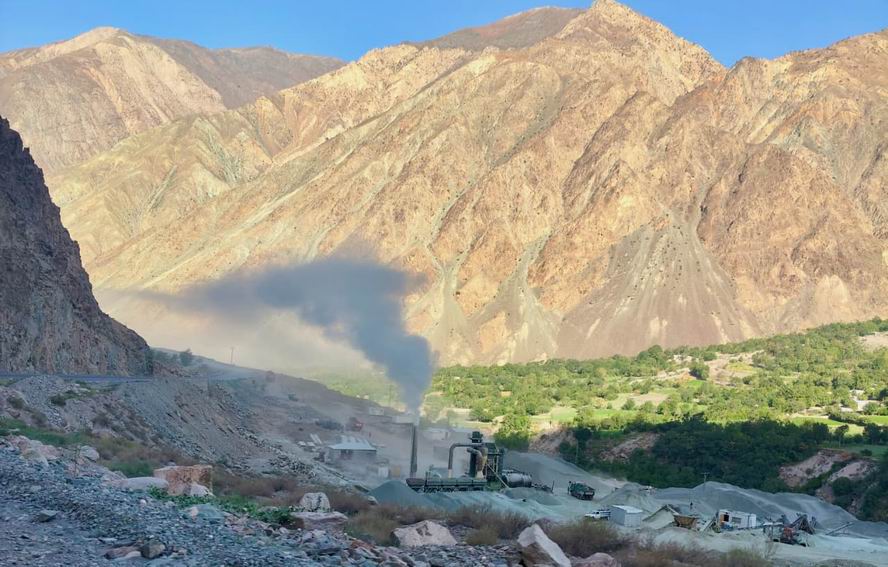
The Bigger Picture: Total Dust Generation:
PM₁₀ represents only the finer fraction of dust emissions. In many unpaved-road environments, respirable PM₁₀ constitutes only 20–30% of total fugitive dust. Applying this relationship suggests total annual dust production of approximately 40,000 tonnes per year. This enormous quantity illustrates how seemingly modest traffic volumes can produce substantial environmental loading when road surfaces remain unpaved.
Where Does All That Dust Go
It is for sure that in airshed valleys like Chitral dust does not simply disappear. Engineering assumptions indicate that approximately 70% of generated dust settles within 100 metres of the road corridor. That equates to roughly 28,000 tonnes of dust deposited annually along the valley floor.
This deposition affects virtually every component of the surrounding environment, from crops and grazing lands to rivers, forests, settlements, and glaciers.
A Threat to Mountain Glaciers:
Perhaps the most concerning consequence involves glacier health. The Chitral–Mastuj corridor traverses one of Pakistan’s most heavily glaciated mountain regions. Fine dust particles are transported upslope by mountain-valley wind systems and eventually settle on snowfields and glacier surfaces. This dust darkens the snow cover and glaciers surfaces, reducing its reflectivity, or albedo. Reduced albedo means greater solar energy absorption, faster snow and glacial ice melting, earlier seasonal melt and rapid glacier retreat. This what the region has been experiencing from late nineties to date. Resultantly Chitral-Mastuj valley has experienced more Glacial Lake Outburst Floods (GLOFs) from 2000 to 2024 including the most famous Sonoghor Glacier Outburst (2007), Bindo Gol and Boni Gol Glacier Outbursts in 2010, Reshun Glacier Outburst (2013, 2015, 2022) etc. From early 2000 to 2023 Chitral has experienced 15 devastating GLOF events (DDMU and PMDA Annual Reports)
Scientific research has shown that dust deposition can reduce snow reflectivity by 5–20%, depending on particle concentration and composition. In glacier-fed watersheds already experiencing rising temperatures, dust acts as an additional stressor that accelerates melt processes.
Potential long-term consequences include:
Air Quality and Public Health
Fine particulate matter poses significant health risks. Communities located along unpaved mountain roads frequently experience PM₁₀ concentrations several times higher than recommended health guidelines during dry weather.
The potential health issues frequently faced by the local communities in the area are Chronic bronchitis, Asthma, Respiratory infections, Eye irritation, Cardiovascular stress, Reduced visibility etc. Vulnerabilities of Children, older adults, and individuals with existing respiratory illnesses have increased many folds in the past two decades.
Agriculture Under a Layer of Dust:
The Chitral valley supports valuable orchards and agricultural lands. The area is famous for its nutritious and healthy fruits and other agricultural products of wide varieties. The dust settling on leaves reduces Photosynthesis, Stomatal conductance, Plant growth, Fruit quality and ultimately Crop productivity. Significant Important local fruit species including apricot, apple, walnut, cherry, mulberry, pears, grapes etc. are particularly susceptible during the growing season when leaf surfaces remain coated with fine dust. Over time, reduced productivity may affect both household food security and local agricultural incomes. It’s important to note here that prevalence of stunting among children under 5 years of age in Chitral region is 47% (National Nutrition Survey 2019-20) and Multidimensional Poverty in the region is 31% (Multi Indicators Cluster Survey 2018-19).
Effects on Alpine Rangelands:
Subsistence Agriculture and livestock rearing are predominant sources of livelihoods for over 60% of local population in district Chitral (KP-Crop Statistics, 2020). Mountain pastures provide essential grazing resources for livestock. The dust accumulation suppresses vegetation by blocking sunlight, reducing transpiration, altering soil surface conditions and limiting growth of grasses and alpine herbs
Progressive reductions in forage productivity could affect pastoral livelihoods that depend on healthy rangelands.
Rivers Carry the Legacy of Dust:
Not all the dust remains on land. Seasonal rainfall and snowmelt wash deposited sediments into rivers and irrigation channels. This contributes to higher suspended sediment loads, increased turbidity (what we are witnessing right now), abrasion of hydraulic infrastructure and sediment accumulation in irrigation canals. Such processes can increase maintenance costs while reducing water delivery efficiency.
Local Climate Implications:
Although dust is unlikely to alter climate significantly at regional scales, its local effects are very imperative. As mentioned earlier that dust contributes to reduced snow reflectivity, enhanced glacier melt, increased absorption of solar radiation, warmer near-surface temperatures and earlier disappearance of seasonal snow cover. Together, these changes reduce the natural water-storage function of mountain snowpacks, potentially altering downstream water availability.
Ecological Consequences:
Dust deposition extends beyond physical landscapes. Fine dust/sediments influence ecological processes by altering soil chemistry, changing microbial communities, suppressing mosses and lichens, affecting pollinating insects and reducing habitat quality for alpine vegetation. These subtle changes can gradually reshape sensitive mountain ecosystems over time.
Bottomline:
The estimated dust burden along the Chitral–Mastuj road illustrates how relatively low traffic volumes can create disproportionately large environmental impacts in fragile mountain landscapes.
While these figures should be regarded as engineering estimates rather than direct measurements, they highlight the need for detailed field investigations and targeted mitigation measures.
- Future studies must include:
- Continuous traffic monitoring
- Road silt-content analysis
- PM₁₀ and PM₂.₅ air-quality measurements
- Dust deposition monitoring
- Meteorological observations
- Glacier surface sampling
- Remote sensing of dust transport
- Seasonal environmental assessments
Such research would allow the preliminary estimates presented here to be validated and refined, providing a stronger scientific basis for environmental planning and infrastructure management.
The Chitral–Mastuj road is a vital transportation corridor that supports communities, trade, and tourism. However, its predominantly unpaved surface also represents a significant source of fugitive dust. Preliminary engineering estimates suggest annual emissions of approximately 40,000 tonnes of dust, including nearly 9,600 tonnes of PM₁₀, with around 28,000 tonnes settling within the surrounding valley.
The implications extend far beyond roadside nuisance. Dust affects human health, agriculture, alpine ecosystems, water resources, and glacier stability, potentially amplifying the impacts of climate change in one of Pakistan’s most environmentally sensitive mountain regions.
Reducing these impacts through improved road surfacing, dust suppression, vegetation restoration, and systematic environmental monitoring would not only improve local air quality but also help protect the ecological integrity and long-term water security in Chitral and further down in the country.