Takht-i-Bahi’s timeless Buddhist heritage captivates international tourists
TAKHTBHAI, (APP): Nestled on a hilltop in Mardan district, the ancient Buddhist monastic complex of Takht-i-Bahi continues to captivate international visitors with its remarkable architecture, spiritual legacy and enduring connection to the glorious Gandhara civilization.
Tourists from Italy, China, Canada and Thailand visited the UNESCO World heritage site, exploring its centuries-old monasteries, stupas, meditation chambers and courtyards while discovering the historical and cultural significance of one of South Asia’s best-preserved Buddhist religious complexes.
For most of these visitors, the journey was more than a sightseeing experience but an opportunity to step into a civilization where religion, philosophy, scholarship, architecture and art flourished together, leaving behind an extraordinary legacy carved in stone.
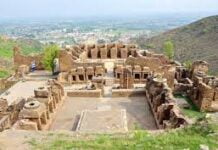
Perched majestically on a hilltop, Takht-i-Bahi stands as a remarkable testament to the artistic excellence and religious traditions of ancient Gandhara.
Its stone stairways, meditation cells, open courtyards, stupas and massive walls, featuring distinctive Gandhara diaper-style masonry, continue to tell stories of a vibrant Buddhist monastic life that flourished centuries ago.
“At Takht-i-Bahi, history is not buried beneath layers of earth. It stands in the open, in stone stairways worn by countless footsteps, meditation cells, courtyards, stupas and massive walls constructed with distinctive Gandhara diaper-style masonry,” said Bakhtzada Khan, Director of Archaeology and Museums, Khyber Pakhtunkhwa, while talking to APP.
“Every stone here speaks. It is not merely an archaeological site but a narrative carved in stone, tracing its roots to the early centuries before Christ, through the zenith of the Kushan dynasty and beyond,” he added.
Recognized as a UNESCO world heritage site in 1980, Takht-i-Bahi is widely regarded as one of the most remarkably preserved Buddhist monastic complexes in South Asia. Its significance extends beyond its antiquity, offering valuable insights into the religious practices, architectural traditions, social organization and intellectual life of the ancient Gandharan civilization.
Over the years, the site has attracted Buddhist pilgrims, monks, historians, researchers, archaeologists and cultural tourists from across the world. While some visitors arrive to explore its archaeological treasures, others seek a spiritual connection with a heritage that continues to hold deep significance for Buddhist communities.
The historical importance of Takht-i-Bahi becomes even more evident when viewed within the wider archaeological landscape of Mardan, which hosts several important remnants of ancient Gandhara.
Around five kilometres from Takht-i-Bahi lies Sahr-i-Bahlol, an ancient fortified settlement believed to date back to the Kushan period. Built on a mound approximately nine metres high, the settlement retains sections of its defensive walls, also featuring the distinctive diaper-style masonry associated with Gandharan architecture.
Nearby Jamal Garhi further enriches the region’s archaeological landscape, demonstrating that Takht-i-Bahi was not an isolated religious centre but part of a wider network of settlements, monasteries and cultural establishments that flourished across ancient Gandhara.
“Together, these sites represent the zenith of Buddhist architectural achievement in the subcontinent,” Bakhtzada Khan said.
The archaeological wealth of Khyber Pakhtunkhwa further highlights the province’s importance as a major centre of Gandharan civilization. According to archaeology authorities, around 2,000 religious and heritage sites and nearly 30,000 artefacts associated with Gandharan civilization have been discovered across the province.
However, despite this extraordinary archaeological wealth, many historical sites remain understudied, inadequately documented or relatively unknown to international audiences, limiting their potential for cultural tourism, academic research and heritage promotion.
Bakhtzada Khan said Takht-i-Bahi was protected under the Ancient Monuments Preservation Act, 1904, and the Antiquities Act, 1975, providing a legal framework for safeguarding its historical and archaeological significance.
Heritage experts, however, believed that legislation alone cannot ensure the long-term preservation of such an invaluable legacy. Sustained financial resources, specialized archaeological expertise, trained conservation personnel, scientific documentation and community participation are equally essential to protect these treasures for future generations.
The growing interest of international tourists in Takht-i-Bahi presents an opportunity for Khyber Pakhtunkhwa to strengthen its cultural tourism sector and introduce the world to the historical richness of Gandhara.
With its magnificent architecture, spiritual atmosphere and centuries-old history, Takht-i-Bahi remains more than a collection of ancient ruins. It is a living reminder of the region’s contribution to world civilization and a cultural bridge connecting modern generations with one of the most remarkable chapters of South Asian history.